
If you are working in the UAE and need your employment contract verified—whether for MWO/POLO processing, OEC requirements, or to avoid delays with related documentation—small mistakes can cost you days or even weeks.
In practice, contract verification is rarely “one standard process.” The requirements depend on:
- Where your visa was issued (Dubai/Northern Emirates vs Abu Dhabi/Al Ain)
- Your worker category (domestic vs skilled/professional vs others)
- Whether you will use in-person verification or an online system (where available)
- Whether the process is shifting to an appointment + centre model (as announced for end of January 2026)
This guide explains the requirements for contract verification in the UAE, how to choose the correct route, and how to reduce the risk of rejection—written in a practical, lawyer-led format.

What Is Contract Verification in the UAE?

Contract verification is the formal review and confirmation of your employment contract by the competent authority to ensure:
- the contract is genuine and complete, and
- the supporting documents match your visa/identity/employer records, and
- the contract meets the required standards for the purpose it will be used for (for many users, this is tied to OFW deployment documentation).
Contract Verification vs Attestation vs Notarization (People Confuse These)
Many applicants use these terms interchangeably, but they are not the same:
- Contract verification (MWO/POLO/DMW context): confirms the employment contract and checks required supporting documents for overseas worker processing. MWO Dubai, for example, clearly provides in-person onsite verification and also an online verification option (as an additional route).
- Notarization (UAE legal formality): confirms signatures and execution before a notary (used in many UAE legal documents; not always the same step as MWO verification).
- Attestation / authentication: a “document legalization” chain used when documents must be accepted by another authority (for example, certain embassy-related use cases).
Why this matters: choosing the wrong process is one of the most common reasons people get delayed—because they complete a step that does not satisfy the requirement of the authority they are dealing with.
Who Needs Contract Verification in the UAE?
Contract verification is not optional for many workers in the UAE. Whether you must verify your contract—and where you must do it—depends mainly on your worker category and the Emirate that issued your visa.
Understanding this distinction early avoids being turned away for applying to the wrong authority.
Domestic Workers (Housemaids, Nannies, Drivers, Private Nurses)
Domestic workers are among the most strictly regulated categories for contract verification.
Contract verification is typically required when:
- renewing an existing contract,
- changing employers,
- preparing documents for overseas deployment or return processing.
In Dubai and the Northern Emirates, this process is handled through Migrant Workers Office Dubai.
In Abu Dhabi and Al Ain, applications fall under POLO Abu Dhabi, which applies stricter appointment and entry rules.
Domestic workers are usually required to appear in person, unless specific authorization rules apply.
Skilled and Professional Workers (Company-Sponsored Employees)
Skilled and professional workers include:
- office staff,
- engineers,
- technicians,
- hospitality workers,
- healthcare and service professionals.
Contract verification is usually required when:
- the worker has no prior overseas employment record, or
- the worker changed employers onsite, or
- the contract is needed for OEC or deployment-related processing.
Verification checks typically include:
- consistency between the employment contract, visa, and employer records,
- confirmation that the contract terms meet required standards.
Depending on jurisdiction, this may be done:
- in person, or
- via an online contract verification system where available.
Workers Without Prior Registration or With Employer Changes
If you fall under any of the following, contract verification is almost always required:
- no existing overseas employment record,
- changed employers while already in the UAE,
- returning home and needing updated documentation,
- contract details do not fully match visa or employer records.
These cases receive closer scrutiny, and incomplete submissions are frequently delayed or rejected.
Dubai vs Abu Dhabi: Why Jurisdiction Matters
One of the most common mistakes is applying to the wrong office.
| Visa Issued In | Responsible Office | Key Notes |
|---|---|---|
| Dubai, Sharjah, Ajman, UAQ, RAK, Fujairah | MWO Dubai | Walk-in or online routes available (subject to updates) |
| Abu Dhabi, Al Ain | POLO Abu Dhabi | Appointment rules strictly enforced; “no appointment, no entry” |
Applying to the wrong jurisdiction can result in automatic refusal, even if your documents are otherwise complete.
When Legal Guidance Becomes Important
You should consider legal assistance if:
- your employer details are inconsistent across documents,
- you are unsure which authority has jurisdiction,
- your contract needs amendment or clarification before submission,
- you are on a tight timeline (flight or OEC appointment).
At this stage, guidance from a Labour & Employment Lawyer or Contract Lawyer can prevent costly back-and-forth with authorities. You can explore our related services through Our Services page.
Requirements for Contract Verification in the UAE (Complete Checklist)
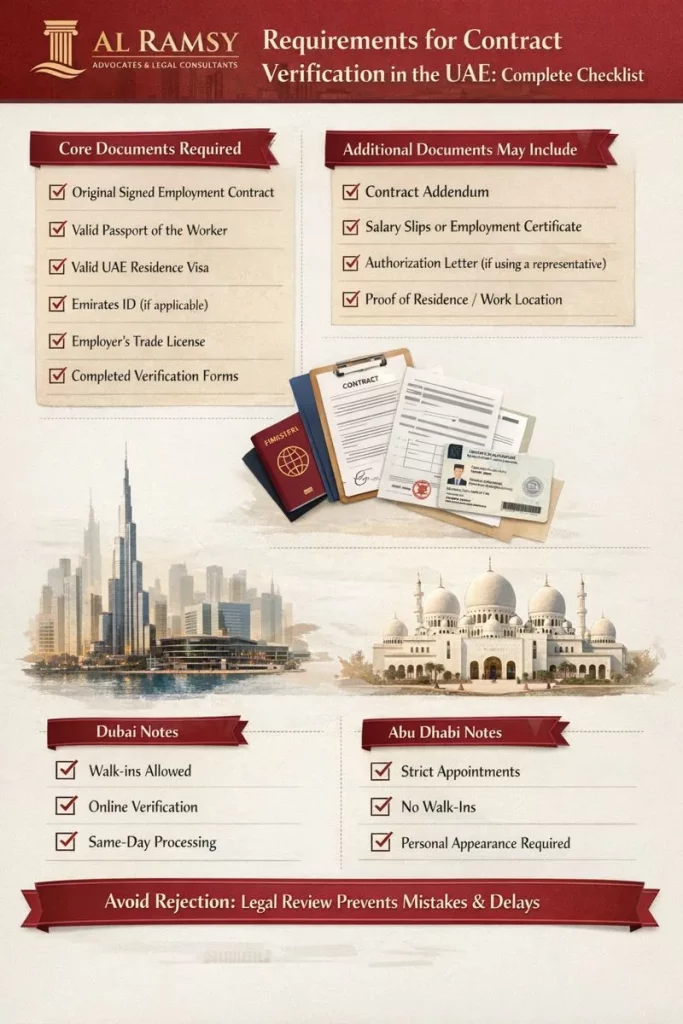
While requirements vary slightly depending on Dubai vs Abu Dhabi and worker category, most contract verification applications are rejected for one reason: missing or inconsistent documents.
Below is a lawyer-verified master checklist used in practice, followed by important jurisdictional differences.
Core Documents Required for Contract Verification
These documents are almost always required, regardless of category:
- Original signed employment contract
– Must be complete, properly signed by both employer and employee
– Any missing page, signature, or annex may result in rejection - Valid passport of the worker
– Usually minimum 6 months validity
– Copies often required in addition to originals - Valid UAE residence visa
– Must match the employer named in the contract - Emirates ID (where applicable)
– Copies typically required; original may be requested for verification - Employer information
– Company trade license or business registration
– Identification of employer or authorized signatory - Completed verification forms
– Authority-specific forms (MWO / POLO / online portal)
Additional Documents That May Be Required
Depending on your situation, authorities may request:
- Contract addendum
– Common for domestic workers
– Used to insert mandatory clauses missing from the main contract - Proof of employment or activity
– Salary slips
– Certificate of employment
– Company ID - Authorization letter
– If documents are submitted by a representative
– Must be signed by the employer or worker (as applicable) - Proof of residence or work location
– Especially when visa and workplace Emirate differ
Authorities expressly reserve the right to request additional documents during review.
Dubai vs Abu Dhabi – Key Requirements Differences
Understanding jurisdictional rules is critical.
Dubai and Northern Emirates
Applications are handled through Migrant Workers Office Dubai.
Key points:
- Walk-in verification is permitted in many cases
- Online contract verification is also available for eligible workers
- Same-day processing is common for in-person submissions when documents are complete
- Cash fees are typically collected on site
This flexibility makes Dubai the faster jurisdiction—but only if documents are accurate.
Abu Dhabi and Al Ain
Applications fall under POLO Abu Dhabi.
Key points:
- Strict appointment system
- “No appointment, no entry” policy enforced
- Personal appearance is often required
- Walk-ins are rarely accepted
Applying without a confirmed appointment almost always results in refusal.
Common Documentation Errors That Cause Rejection
Authorities frequently reject applications due to:
- Employer name on contract not matching visa or trade license
- Missing signatures or unsigned annexes
- Outdated contract format
- Incorrect worker category
- Submitting to the wrong Emirate office
Many of these errors can be resolved before submission through a legal review—saving days or weeks.
Practical Tip From Legal Practice
If your contract:
- was prepared informally,
- lacks annexes,
- or does not fully match visa records,
do not submit it as-is.
A short review by a Contract Lawyer or Labour & Employment Lawyer can prevent rejection and repeated appointments. You can review available support under Our Services.
Step-by-Step Contract Verification Process in the UAE
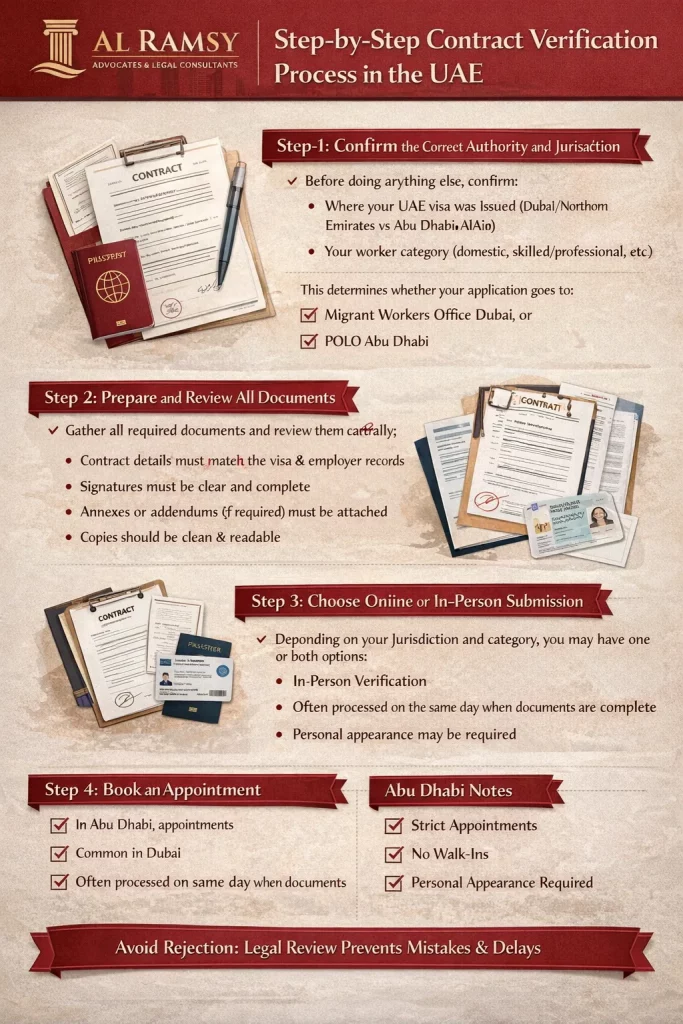
Once you know where to apply and what documents are required, the next challenge is following the correct process. Most delays happen not because documents are missing, but because steps are done out of sequence or through the wrong channel.
Below is the practical, end-to-end process used in Dubai and Abu Dhabi.
Step 1: Confirm the Correct Authority and Jurisdiction
Before doing anything else, confirm:
- Where your UAE visa was issued (Dubai/Northern Emirates vs Abu Dhabi/Al Ain)
- Your worker category (domestic, skilled/professional, etc.)
This determines whether your application goes to:
- Migrant Workers Office Dubai, or
- POLO Abu Dhabi
Applying to the wrong office almost always leads to refusal, even if your documents are perfect.
Step 2: Prepare and Review All Documents
Gather all required documents and review them carefully:
- Contract details must match the visa and employer records
- Signatures must be clear and complete
- Annexes or addendums (if required) must be attached
- Copies should be clean and readable
Legal tip: If the employer’s details or job title differ even slightly across documents, resolve this before submission.
Step 3: Choose Online or In-Person Submission (Where Available)
Depending on your jurisdiction and category, you may have one or both options:
In-Person Verification
- Common in Dubai
- Often processed on the same day when documents are complete
- Personal appearance may be required
- Cash fees usually collected on site
Online Contract Verification
- Available for eligible workers through official systems
- Requires uploading scanned documents
- Allows status tracking and digital confirmation
- Not all categories qualify for online processing
Online systems reduce queues but still apply strict document checks.
Step 4: Book an Appointment (If Required)
In Abu Dhabi, appointments are typically mandatory.
Key points:
- Entry without a confirmed appointment is usually denied
- Appointment slots can fill quickly
- Late or incomplete submissions are rescheduled
Always confirm your appointment details before appearing in person.
Step 5: Authority Review and Verification
The reviewing authority will:
- Validate the authenticity of the contract
- Check compliance with required standards
- Confirm employer legitimacy
- Review supporting documents
If issues are found, you may be asked to:
- submit additional documents,
- amend the contract,
- or rebook for a later date.
Step 6: Payment of Fees
Fees vary by authority and category but are generally modest.
Important notes:
- Payment is usually cash-only for in-person processing
- Official receipts are issued
- Avoid intermediaries or “fixers”
Step 7: Collection of Verified Contract
Once approved:
- Verified contracts are usually released the same day or within a short timeframe
- Online applicants may receive digital confirmation
- These verified documents are then used for OEC processing or related requirements
When Timing or Complexity Matters?
If you are:
- close to a flight date,
- unsure about jurisdiction,
- dealing with contract inconsistencies,
getting legal support early can save significant time.
You may speak with a Labour & Employment Lawyer or Contract Lawyer through Our Services to ensure your submission is correct before filing.
What Happens If You Do Not Verify Your Contract?
Failure to verify your contract can lead to:
- OEC denial
- Travel delays
- Airport processing issues
- Rejected employer change applications
- Contract substitution complications
Delays can cost flights, employer approvals, and significant time.
Common Reasons for Contract Verification Rejection (And How to Avoid Them)

Contract verification rejections in the UAE are rarely random. In practice, the same issues appear again and again—most of them avoidable with proper preparation.
Below are the most frequent rejection causes, explained in practical terms, with guidance on how to fix them.
1. Mismatch Between Contract and Visa Details
Why it happens:
- Employer name on the contract differs from the visa or trade license
- Job title does not match immigration records
How to avoid it:
- Cross-check employer name, trade license number, and job title across all documents
- Amend the contract before submission if discrepancies exist
When legal help is useful:
If the employer structure changed (branch vs head office), a Contract Lawyer can align documentation legally.
2. Missing Signatures or Incomplete Pages
Why it happens:
- Annexes not signed
- Contract pages missing initials
- Scanned copies submitted without originals available
How to avoid it:
- Ensure all pages and annexes are signed where required
- Bring originals even when submitting copies
3. Incorrect Worker Categor
Why it happens:
- Domestic workers submitted as skilled employees
- Skilled workers using domestic worker contract formats
How to avoid it:
- Confirm your worker category before submission
- Use the correct contract template and addendums
Misclassification almost always results in rejection.
4. Submitting to the Wrong Authority
Why it happens:
- Visa issued in Abu Dhabi but submission made in Dubai
- Applicant unaware of jurisdiction rules
How to avoid it:
- Confirm visa issuing Emirate before booking appointments
- Apply only to the authority with jurisdiction
5. Missing Mandatory Clauses or Addendums
Why it happens:
- Contracts lack required terms
- Addendums not attached or not signed
How to avoid it:
- Review contract contents carefully
- Attach authority-issued addendums where required
6. Attempting to Use Unauthorized Intermediaries
Why it happens:
- Applicants rely on “fixers” or unofficial agents
How to avoid it:
- Deal only with official offices or qualified legal professionals
- Submit documents personally or through authorized representatives
How a Lawyer Reduces Rejection Risk?
A lawyer’s role is not to “speed things up” unofficially, but to:
- ensure documents are legally aligned,
- identify issues before submission,
- handle amendments properly,
- guide you to the correct authority.
If your case involves inconsistencies, tight timelines, or prior rejections, support from a Labour & Employment Lawyer or Contract Lawyer can be decisive. You can explore assistance through Our Services.
Processing Time, Fees, and Online vs In-Person Verification
Understanding how long contract verification takes, what it costs, and which channel to use helps you plan flights, OEC appointments, and employer coordination without last-minute stress.
Typical Processing Time
Processing time varies by authority, submission method, and document completeness:
- Dubai (MWO Dubai)
- In-person verification: often same-day release when documents are complete
- Online verification: timeline depends on system review and document validation
- Abu Dhabi (POLO Abu Dhabi)
- Appointment-based review
- Processing may take several working days, especially if clarifications are required
Practical note: Re-submissions reset timelines. A single missing item can add days.
Fees (Indicative)
- In-person verification (Dubai): modest, typically cash-only at the counter
- Online verification: payable through the official portal/payment gateway (where available)
Always obtain an official receipt. Avoid third parties requesting unofficial “service fees.”
Online vs In-Person: Which Should You Choose?
| Factor | Online Verification | In-Person Verification |
|---|---|---|
| Availability | Limited to eligible categories | Broadly available |
| Speed | Convenient, but review-based | Often same-day (Dubai) |
| Personal Appearance | Not required | Often required |
| Risk of Rejection | Document-quality dependent | Immediate feedback |
| Best For | Clear, standard cases | Tight timelines or complex cases |
Tip: If your contract needs correction or addendums, in-person review can resolve issues faster.
When Should You Seek Legal Help?
Legal assistance is recommended if:
- Your employer details changed
- Your job title does not match visa
- You have prior rejection
- You are on urgent travel timeline
- Your contract needs amendment
How a Lawyer Can Help With Contract Verification in the UA
Legal assistance is most valuable when accuracy and timing matter. A lawyer can:
- Pre-review your contract pack to catch mismatches before submission
- Draft or amend contracts/addendums to meet authority requirements
- Route your case to the correct authority (Dubai vs Abu Dhabi)
- Coordinate submissions and authorized representation where permitted
For targeted support, speak with a Labour & Employment Lawyer or Contract Lawyer via Our Services.
Requirements for Contract Verification in UAE – Frequently Asked Questions
What is contract verification in the UAE?
Contract verification in the UAE is the official confirmation that an employment contract is genuine, complete, and compliant with applicable requirements before it is accepted for deployment, visa-related, or overseas worker documentation purposes.
It ensures that:
- the contract matches the worker’s visa and employer records, and
- mandatory terms and supporting documents are in place.
This process is commonly required for overseas workers and is handled by designated authorities depending on where the visa was issued.
What are the requirements for contract verification in the UAE?
The basic requirements for contract verification in the UAE typically include:
- a signed employment contract,
- a valid passport of the worker,
- a valid UAE residence visa,
- Emirates ID (where applicable), and
- employer identification or company documents.
Additional documents may be required depending on the worker category, Emirate of visa issuance, and reviewing authority.
Which authority handles contract verification in Dubai?
Contract verification in Dubai and the Northern Emirates is generally handled by the Migrant Workers Office (MWO Dubai).
Workers whose visas were issued in:
- Dubai
- Sharjah
- Ajman
- Umm Al Quwain
- Ras Al Khaimah
- Fujairah
are typically processed under MWO Dubai jurisdiction.
Which authority handles contract verification in Abu Dhabi?
Contract verification for visas issued in Abu Dhabi and Al Ain is handled by POLO Abu Dhabi.
POLO Abu Dhabi applies:
- strict appointment rules, and
- limited walk-in acceptance.
Applicants without a confirmed appointment are usually not admitted.
Is contract verification mandatory in the UAE?
Contract verification is mandatory in many situations, especially for overseas workers who require verified employment documents for deployment or return processing.
It is commonly required when:
- a worker changes employers onsite,
- a worker has no prior overseas employment record, or
- updated documentation is needed for official processing.
Can contract verification be done online in the UAE?
Yes, contract verification can be done online for eligible cases through official systems, subject to worker category and authority rules.
Online verification:
- allows document upload and status tracking,
- does not apply to all worker categories, and
- still requires strict document compliance.
Some cases continue to require in-person appearance, even if online options exist.
Do I need an appointment for contract verification?
Yes, an appointment is required for contract verification in Abu Dhabi, while Dubai allows broader access depending on the case.
- Abu Dhabi: No appointment, no entry
- Dubai: walk-in and online options may be available
Always confirm appointment requirements before appearing in person.
How long does contract verification take in the UAE?
Contract verification in Dubai may be completed on the same day for in-person submissions with complete documents, while Abu Dhabi cases often take several working days.
Processing time depends on:
- authority workload,
- document completeness, and
- whether clarifications or amendments are required.
What is the difference between contract verification and contract attestation?
Contract verification confirms the validity and compliance of an employment contract, while contract attestation authenticates a document for recognition by another authority or country.
They serve different legal purposes and are not interchangeable.
Completing the wrong process often results in rejection.
What happens if my contract details do not match my visa or employer records?
If contract details do not match visa or employer records, the application is usually rejected until corrections are made.
Common mismatches include:
- employer name discrepancies,
- incorrect job titles, or
- outdated contract formats.
These issues should be corrected before submission.
Can someone submit contract verification documents on my behalf?
Yes, authorized representatives may submit documents in certain cases, provided proper authorization is submitted and accepted by the authority.
However:
- some categories require personal appearance, and
- authorization rules vary by Emirate and authority.
Is contract verification required for domestic workers?
Yes, domestic workers such as housemaids, nannies, drivers, and private nurses commonly require contract verification, especially for renewals or employer changes.
Domestic worker cases often require:
- contract addendums, and
- stricter review of contract terms.
What are the most common reasons for contract verification rejection?
The most common reasons for rejection include:
- missing signatures or annexes,
- incorrect worker category,
- applying to the wrong authority, and
- inconsistencies between contract, visa, and employer records.
Most rejections are preventable with proper document review.
Can a lawyer help with contract verification in the UAE?
Yes. A lawyer can review contracts, correct inconsistencies, draft addendums, and guide submissions to the correct authority.
Legal assistance is particularly useful for:
- complex or urgent cases,
- prior rejections, or
- employer or contract inconsistencies.
Do I need legal help for contract verification?
Legal help is not mandatory, but it significantly reduces the risk of rejection, delays, and repeated appointments.
For workers on tight timelines or with non-standard contracts, legal review often saves time and cost.
Do I need appointment for contract verification in Dubai?
Dubai often allows walk-in and online options. However, always confirm current rules before appearing.
Is appointment mandatory in Abu Dhabi?
Yes. POLO Abu Dhabi enforces strict appointment policy.
How long does contract verification take?
Dubai: Often same day.
Abu Dhabi: Several working days depending on review.
Can I verify contract online in UAE?
Yes, for eligible categories in Dubai. Not all workers qualify.
What if my contract and visa job title do not match?
Your application may be rejected. The contract should be amended before submission.
Can someone submit documents for me?
Possibly, with proper authorization. Some categories still require personal appearance.