

Thinking about starting a medical clinic, healthcare company, or life-sciences business in Dubai? You’ve probably heard of Dubai Healthcare City (DHCC), but what does it really mean for you—and your business?
DHCC isn’t just another free zone. It’s a specialised healthcare hub with its own rules, licensing, and compliance requirements. To operate here successfully, you need to understand its legal framework from the very beginning.
This guide cuts through the jargon and marketing hype. It shows you, step by step, what DHCC is, who can operate there, and where legal pitfalls often appear—so you can make smart, informed decisions before you invest.
Need expert guidance? Contact Al Ramsy Advocates today to ensure your DHCC setup is fully compliant and legally secure.
What Is Dubai Healthcare City (DHCC)?
Definition of DHCC
Dubai Healthcare City (DHCC) is a dedicated healthcare and life sciences free zone established by the Government of Dubai to attract medical, clinical, pharmaceutical, wellness, and healthcare-related businesses into a single regulated ecosystem.
DHCC operates under its own legal and regulatory framework and is overseen by the Dubai Healthcare City Authority (DHCA), which acts as both the free zone authority and the healthcare regulator.
From a legal standpoint, DHCC is:
- A free zone jurisdiction within Dubai
- Designed exclusively for healthcare, medical, and allied services
- Subject to sector-specific regulation, not just standard company law
This makes DHCC fundamentally different from multi-purpose free zones in the UAE.
Is DHCC a Free Zone in Dubai?
Yes. DHCC is a specialised free zone, which means:
- 100% foreign ownership is permitted
- Companies are licensed directly by the DHCC Authority
- Federal UAE Commercial Companies Law applies only where adopted by DHCC regulations
- Healthcare activities are regulated in parallel with corporate licensing
However, unlike general free zones, DHCC businesses must also comply with healthcare regulatory standards, clinical governance rules, and professional licensing requirements.
This dual layer of regulation—corporate + medical—is where many businesses encounter legal difficulties if they proceed without proper advice.
Where Is Dubai Healthcare City Located?
Dubai Healthcare City is strategically located in Bur Dubai, close to key transport and commercial hubs. It is easily accessible via the Healthcare City Metro Station, making it convenient for patients, staff, and visiting professionals.
DHCC is surrounded by:
- Major hospitals and clinics (including well-known facilities such as Mediclinic and Emirates Hospital Healthcare City)
- Residential developments and Dubai Healthcare City hotels
- Academic and research institutions
From a regulatory and operational standpoint, location matters because:
- Facility approvals are linked to zoning and usage compliance
- Medical premises must meet specific fit-out and inspection standards
- Lease agreements are reviewed as part of the licensing process
Why Choose DHCC for Your Healthcare Business?

Dubai Healthcare City is not simply a prestigious address—it is a purpose-built legal and regulatory environment designed to support healthcare delivery, medical education, research, and life sciences. From a legal standpoint, DHCC offers advantages that are difficult to replicate elsewhere in the UAE, provided businesses understand and comply with its framework.
Strategic Location & Infrastructure
DHCC is positioned at the heart of Dubai’s healthcare and academic corridor, with direct access via the Healthcare City Metro Station and proximity to Dubai International Airport. This makes it attractive not only to patients, but also to international practitioners, investors, and healthcare groups.
From a regulatory perspective, DHCC’s infrastructure is designed specifically for healthcare use:
- Buildings are approved for clinical and medical activity
- Facilities are assessed against healthcare-specific design and safety standards
- Leasing arrangements are aligned with licensing requirements
This reduces zoning conflicts that often arise when healthcare businesses attempt to operate in mixed-use commercial areas.
Access to Hospitals, Clinics & Medical Talent
DHCC hosts a concentration of recognised healthcare institutions, including major hospitals, specialist clinics, diagnostic centres, and medical education providers. This creates a regulated medical ecosystem rather than a fragmented commercial environment.
For healthcare operators, this means:
- Easier collaboration with hospitals such as Mediclinic Healthcare City and Emirates Hospital Healthcare City
- Access to licensed medical professionals already familiar with DHCC regulatory standards
- Credibility with insurers, patients, and international partners
From a legal standpoint, operating within an established healthcare zone also reduces reputational and compliance risks, provided licensing conditions are respected.
Regulatory Advantages for Healthcare Companies
One of the primary reasons businesses choose DHCC is the clarity of its regulatory framework.
DHCC is regulated by the Dubai Healthcare City Authority, which:
- Issues company licenses
- Regulates healthcare activities
- Oversees professional licensing in coordination with Dubai’s health regulators
- Conducts inspections and compliance audits
Unlike general free zones, DHCC’s rules are healthcare-specific, meaning:
- Clinical activities are clearly categorised and licensed
- Non-clinical healthcare services are regulated separately
- Advertising, patient data, and medical records are subject to defined standards
For serious healthcare investors, this regulatory clarity offers long-term stability, but only when legal requirements are addressed correctly from the outset.
Types of Businesses Allowed in DHCC
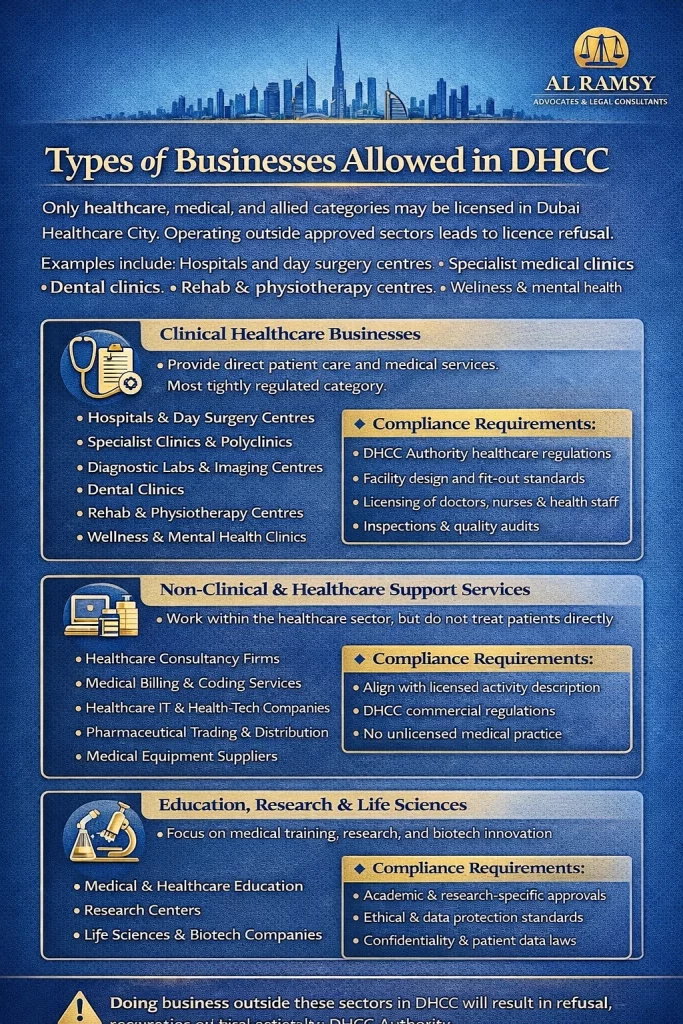
Dubai Healthcare City is not open to all commercial activities. It is a sector-restricted free zone, and only businesses that fall within approved healthcare, medical, or allied categories may be licensed. Understanding these distinctions is essential, as operating outside the permitted scope can lead to licence refusal, suspension, or regulatory action.
From a legal perspective, DHCC businesses are broadly divided into clinical and non-clinical categories, each subject to different approval pathways.
Clinical Healthcare Businesses
Clinical entities are those that provide direct medical or healthcare services to patients. These are the most tightly regulated activities within DHCC.
Examples include:
- Hospitals and day surgery centres
- Specialist medical clinics and polyclinics
- Diagnostic laboratories and imaging centres
- Dental clinics
- Rehabilitation and physiotherapy centres
- Wellness and mental health clinics
Clinical businesses must comply with:
- DHCC Authority healthcare regulations
- Facility design and fit-out standards
- Professional licensing for doctors, nurses, and allied health staff
- Ongoing inspections and quality audits
Failure to meet these requirements can result in licence delays, suspension, or closure, even if the company is otherwise properly incorporated.
Non-Clinical & Healthcare Support Services
Non-clinical businesses do not treat patients directly but operate within the healthcare ecosystem. These are still regulated but follow a less intensive approval process than clinical providers.
Examples include:
- Healthcare consultancy firms
- Medical billing and coding services
- Healthcare IT and health-tech companies
- Pharmaceutical trading and distribution (subject to approvals)
- Medical equipment suppliers
- Training and professional education providers
Although these activities are non-clinical, they must still:
- Align precisely with the licensed activity description
- Comply with DHCC commercial regulations
- Avoid any activity that could be interpreted as unlicensed medical practice
A common legal mistake is assuming that “non-clinical” means “lightly regulated.” In reality, DHCC enforces strict boundaries between licensed and unlicensed healthcare activity.
Education, Research & Life Sciences
DHCC also permits:
- Medical and healthcare education institutions
- Research centres
- Life sciences and biotechnology companies
These entities are often subject to:
- Academic or research-specific approvals
- Ethical compliance requirements
- Data protection and patient confidentiality obligations
For research-driven or education-focused businesses, early legal structuring is essential to ensure activities remain compliant with both DHCC regulations and UAE federal laws.
DHCC Free Zone Licensing Options
Choosing the correct licence type in Dubai Healthcare City is a legal decision, not an administrative one. The licence defines what your company may lawfully do, how it is regulated, and which approvals are required. Selecting the wrong licence—or drafting activities too broadly or too narrowly—is one of the most common causes of delay and regulatory intervention in DHCC.
Clinical Licence
A clinical licence is required for any business that provides direct medical or healthcare services to patients.
This includes:
- Hospitals and clinics
- Diagnostic and imaging centres
- Dental and specialist practices
- Rehabilitation and wellness facilities
Clinical licences are subject to:
- Detailed medical approvals by the DHCC Authority
- Mandatory facility inspections
- Strict compliance with clinical governance standards
- Individual professional licensing for healthcare practitioners
From a legal standpoint, clinical licences carry the highest compliance burden. Any deviation from the approved scope of practice may expose the entity and its professionals to disciplinary action, suspension, or revocation.
Non-Clinical Licence
A non-clinical licence applies to healthcare-related businesses that do not treat patients directly.
Examples include:
- Healthcare consultancy and advisory firms
- Medical education and training providers
- Health IT and digital health companies
- Medical trading and supply businesses
While non-clinical licences are subject to fewer medical requirements, they are still regulated. Companies must ensure:
- Activities are accurately described and approved
- No services cross into unlicensed clinical practice
- Contracts and marketing materials remain compliant
Many regulatory disputes arise where non-clinical entities inadvertently perform activities that regulators consider clinical in nature.
Branch vs New Entity
DHCC allows:
- New company incorporation within the free zone
- Branch registration of existing UAE or foreign companies
Branch structures can be attractive for international healthcare groups, but they raise specific legal considerations, including:
- Liability exposure of the parent company
- Corporate governance alignment
- Contract enforceability across jurisdictions
A lawyer-led review is essential before choosing a branch structure, particularly for clinical operators.
Step-by-Step Process to Set Up a Company in DHCC
Setting up a company in Dubai Healthcare City is not a one-form process. It is a regulated, sequential procedure where corporate approvals and healthcare approvals run in parallel. From a legal standpoint, skipping or mis-ordering steps is one of the fastest ways to trigger delays or rejections.
Below is the legally correct, practitioner-approved process used in DHCC.
Step 1: Select the Business Activity and Licence Category
The first step is to identify:
- Whether the business is clinical or non-clinical
- The exact activity description as recognised by DHCC
- Whether the activity requires medical regulation, professional licensing, or both
This step determines:
- The licence category
- The approval authorities involved
- Facility and staffing requirements
Legal risk:
If the activity description is inaccurate or overly broad, the application may be rejected or restricted later, even after incorporation.
Step 2: Determine Legal Structure and Shareholding
You must then determine:
- Whether the entity will be a new free zone company or a branch
- Shareholding structure (individuals or corporate shareholders)
- Authorised signatories and governance structure
At this stage, corporate documents such as the Memorandum of Association and board resolutions must align with DHCC regulations and UAE law.
👉 This is where corporate legal review is essential, particularly for foreign investors or joint ventures.
(See: Business Law and Corporate Law support via Al Ramsy Advocates.)
Step 3: Initial Approval from DHCC Authority
An application for initial approval is submitted to the DHCC Authority, including:
- Proposed business activities
- Shareholder and director details
- Preliminary corporate documents
Initial approval confirms that:
- The activity is permitted in DHCC
- The structure is acceptable in principle
It does not authorise operations.
Step 4: Medical Licensing & Professional Approvals (If Applicable)
For clinical businesses, this is the most sensitive stage.
It involves:
- Medical facility approval
- Scope of services assessment
- Professional licensing for doctors, nurses, and allied staff
- Compliance with healthcare quality and safety standards
Medical licensing in DHCC interacts with Dubai’s wider healthcare regulatory framework. Errors at this stage often result in months of delay or licence rejection.
Step 5: Facility Lease, Fit-Out & Inspection
Before final licensing:
- The company must secure a DHCC-approved premises
- The facility must be fitted out according to medical design standards
- Inspections are conducted before approval is granted
Lease terms are reviewed as part of the licensing process, making contractual drafting critical at this stage.
Step 6: Final Licence Issuance & Commercial Registration
Once all approvals are secured:
- The DHCC trade licence is issued
- The company is registered as a legal entity
- The business may begin operations strictly within the licensed scope
Any change to activities, ownership, or structure after licensing requires formal amendment approval.
Legal and Regulatory Requirements in DHCC
Operating in Dubai Healthcare City is governed by a dual regulatory framework. Businesses must comply with both free zone corporate regulations and healthcare-specific regulatory standards. This is where DHCC differs fundamentally from general-purpose free zones—and where most legal exposure arises if compliance is treated lightly.
DHCC Authority (DHCA) Regulations
All entities operating within DHCC are regulated by the DHCC Authority through a dedicated regulatory regime that covers:
- Company incorporation and licensing
- Approved business activities and scope of services
- Ongoing compliance, audits, and inspections
- Enforcement actions, penalties, and licence suspension
From a legal standpoint, DHCC regulations operate in addition to applicable UAE federal laws. Where DHCC rules are more specific, they prevail within the free zone.
Key risk area:
Businesses often assume that federal company law alone governs their operations. In DHCC, this assumption is incorrect. Free zone regulations are actively enforced and violations can result in immediate regulatory action.
Corporate Governance & Compliance Obligations
DHCC companies must maintain:
- Proper corporate records
- Valid constitutional documents
- Clearly defined management and signing authority
- Compliance with approved activities at all times
Changes to:
- Shareholding
- Management
- Capital
- Business activities
require prior approval from the DHCC Authority. Informal or undocumented changes—even if agreed between partners—have no legal effect until formally approved and registered.
For complex ownership structures or joint ventures, legal oversight is essential to ensure that governance arrangements remain enforceable under UAE law. This is where structured corporate and commercial advice becomes critical.
Employment & Contractual Requirements
Healthcare businesses in DHCC are subject to:
- UAE labour law
- DHCC-specific employment and professional conduct standards
- Contractual compliance for medical staff and consultants
Employment contracts, service agreements, and consultancy arrangements must be:
- Properly structured
- Legally compliant
- Aligned with licensing conditions
Misaligned contracts can expose businesses to:
- Labour disputes
- Regulatory scrutiny
- Invalidation of professional approvals
This is particularly relevant where senior medical professionals are engaged under complex or hybrid arrangements.
Medical Licensing and Approvals in Dubai
Medical licensing is the most legally sensitive aspect of operating in Dubai Healthcare City. Even where a company is properly incorporated and licensed as a business, no medical activity may commence unless all professional and facility approvals are in place. Many enforcement actions in DHCC arise not from bad faith, but from misunderstanding how Dubai’s healthcare regulators interact.
DHCC vs DHA vs MOHAP – Who Regulates What?
A common point of confusion is the relationship between different healthcare authorities in Dubai and the UAE.
In simplified terms:
- DHCC Authority (DHCA) regulates:
- Healthcare facilities operating inside DHCC
- Licensing of clinical activities within the free zone
- Compliance with DHCC healthcare regulations
- Dubai Health Authority (DHA) regulates:
- Healthcare professionals’ qualifications and licensing
- Certain professional standards applicable across Dubai
- MOHAP (federal level) may be relevant in limited cross-emirate or federal healthcare matters
For DHCC-based businesses, DHCA is the primary regulator, but professional credentials and practitioner licensing often require coordination with DHA frameworks. This dual oversight is technical and procedural, and errors commonly lead to licensing delays.
Professional Licensing for Doctors & Medical Staff
All healthcare professionals working in DHCC—including doctors, dentists, nurses, and allied health staff—must:
- Hold recognised qualifications
- Obtain professional approval through the applicable licensing pathway
- Work strictly within their approved scope of practice
Professional licensing is individual-specific. A clinic cannot rely on its facility licence alone to operate.
Legal consequences of non-compliance include:
- Suspension of individual practitioners
- Suspension or revocation of the facility licence
- Regulatory penalties and reputational damage
This is why medical licensing should never be treated as an administrative afterthought.
Common Legal Challenges When Operating in DHCC
Despite DHCC’s structured framework, disputes and regulatory issues arise regularly. In practice, the most common legal challenges include:
- Licensing delays caused by incorrect activity classification
- Facility non-compliance due to inadequate fit-out or inspection failures
- Employment disputes involving healthcare professionals
- Contractual conflicts between shareholders, partners, or service providers
- Regulatory enforcement actions for operating outside licensed scope
Many of these issues can be prevented with early legal involvement—particularly during structuring, licensing, and contract drafting stages.
How a Lawyer Can Help With DHCC Business Setup
A lawyer’s role in DHCC setup goes beyond paperwork. Legal support typically includes:
- Structuring the company to align with DHCC regulations
- Drafting and reviewing incorporation documents and shareholder arrangements
- Advising on regulatory approvals and licensing strategy
- Reviewing medical service agreements and employment contracts
- Preventing compliance breaches that lead to enforcement or disputes
For businesses operating in a regulated healthcare environment, legal oversight is not optional—it is risk management.
Why Choose Al Ramsy Advocates for DHCC Legal Services
Al Ramsy Advocates & Legal Consultants provides end-to-end legal support for businesses operating in Dubai Healthcare City.
Our firm offers:
- Licensed UAE advocates with 25+ years of experience
- Deep expertise in corporate, healthcare-adjacent, and regulatory law
- Proven capability in handling complex licensing and compliance matters
- Integrated support across corporate structuring, contracts, employment, and dispute resolution
Whether you are establishing a clinic, expanding an international healthcare group, or restructuring an existing DHCC entity, our lawyers ensure that your business is legally compliant, commercially protected, and enforcement-ready.
👉 To explore how we can assist, visit our Services page or speak directly with our legal team for tailored guidance.
Frequently Asked Questions (FAQs)
What is DHCC in Dubai?
Dubai Healthcare City (DHCC) is a specialised healthcare free zone in Dubai dedicated to medical services, healthcare education, research, life sciences, and related support activities. It operates under its own regulatory authority and allows 100% foreign ownership, subject to strict healthcare and licensing compliance.
What does DHCC stand for?
DHCC stands for Dubai Healthcare City, a government-established healthcare free zone designed to regulate and support hospitals, clinics, medical professionals, and healthcare-related businesses within a controlled legal framework.
Is Dubai Healthcare City a free zone?
Yes. Dubai Healthcare City is a specialised free zone in Dubai. It permits 100% foreign ownership and issues its own business licences. However, unlike general free zones, DHCC is subject to healthcare-specific regulation and medical licensing requirements.
Where is Dubai Healthcare City located?
Dubai Healthcare City is located in Bur Dubai, near Oud Metha, and is directly accessible via the Healthcare City Metro Station on the Dubai Metro Green Line. Its central location makes it easily accessible for patients, staff, and international visitors.
What businesses are allowed in DHCC?
Only healthcare-related businesses are permitted in DHCC, including:
- Hospitals and medical clinics
- Diagnostic and rehabilitation centres
- Healthcare consultancies
- Medical education and training providers
- Health-tech and life sciences companies
General commercial businesses are not allowed.
Is DHCC only for hospitals and clinics?
No. While DHCC is best known for hospitals and clinics, it also licenses non-clinical healthcare businesses, such as medical consultancy firms, healthcare IT companies, education providers, research institutions, and wellness-related services.
What is the difference between DHCC and DHA?
DHCC is a free zone and regulatory authority, while the Dubai Health Authority (DHA) is Dubai’s emirate-wide healthcare regulator. In DHCC, the DHCC Authority regulates facilities, while professional licensing often aligns with DHA standards. Both authorities may be involved depending on the activity.
Do doctors in DHCC need DHA approval?
Doctors and healthcare professionals in DHCC must obtain professional licensing approval through the applicable regulatory pathway. A clinic licence alone is not sufficient. Practitioners must be individually licensed and approved to work within DHCC.
Can a foreigner own 100% of a DHCC company?
Yes. DHCC allows 100% foreign ownership for both clinical and non-clinical entities, as it is a free zone. No local UAE partner or sponsor is required.
How long does it take to set up a company in DHCC?
Timelines vary depending on the business type:
- Non-clinical businesses may take a few weeks
- Clinical healthcare facilities may take several months due to medical licensing, inspections, and facility approvals
Delays are common where applications are legally incomplete.
How much does it cost to set up a company in DHCC?
Costs depend on:
- Licence type (clinical or non-clinical)
- Facility size and location
- Medical equipment and fit-out requirements
- Professional licensing fees
There is no fixed cost, and underestimating compliance expenses is a common mistake.
What are the main legal risks when operating in DHCC?
Common legal risks include:
- Operating outside licensed activities
- Delays or rejection of medical licensing
- Non-compliant facility fit-outs
- Employment disputes with healthcare professionals
- Regulatory penalties or licence suspension
Most risks arise from inadequate legal structuring at setup stage.
Are there hospitals in Dubai Healthcare City?
Yes. DHCC hosts several well-known hospitals and specialist healthcare providers, including internationally recognised facilities. This concentration enhances credibility but also increases regulatory scrutiny.
Are there hotels near Dubai Healthcare City?
Yes. There are multiple Dubai Healthcare City hotels and nearby accommodations used by patients, medical tourists, visiting doctors, and business executives, making DHCC suitable for international healthcare operations.
Is DHCC suitable for medical tourism businesses?
Yes, but only where the business model complies with DHCC healthcare regulations. Medical tourism operators must ensure they do not provide unlicensed medical services and that all partnerships with clinics and hospitals are legally structured.
Do I need a lawyer to set up a business in DHCC?
While not legally mandatory, engaging a lawyer is strongly recommended. DHCC setup involves corporate law, healthcare regulation, licensing, employment law, and contracts. Legal oversight reduces delays, prevents regulatory breaches, and protects long-term operations.
How can Al Ramsy Advocates help with DHCC matters?
Al Ramsy Advocates provides end-to-end legal support for DHCC businesses, including company setup, licensing strategy, regulatory compliance, contracts, employment matters, and dispute resolution—ensuring your healthcare venture operates lawfully and securely.